Monday, 15 September 2014

How space changes with light

15th August 2014

"Take one or 2 locations where you can conveniently return a number of times in different lighting and photograph on each occasion." 

"In photograph 1 set the camera up in exactly the same position each time. In the second, see how different lighting conditions suggest different viewpoints and compositions." Course material


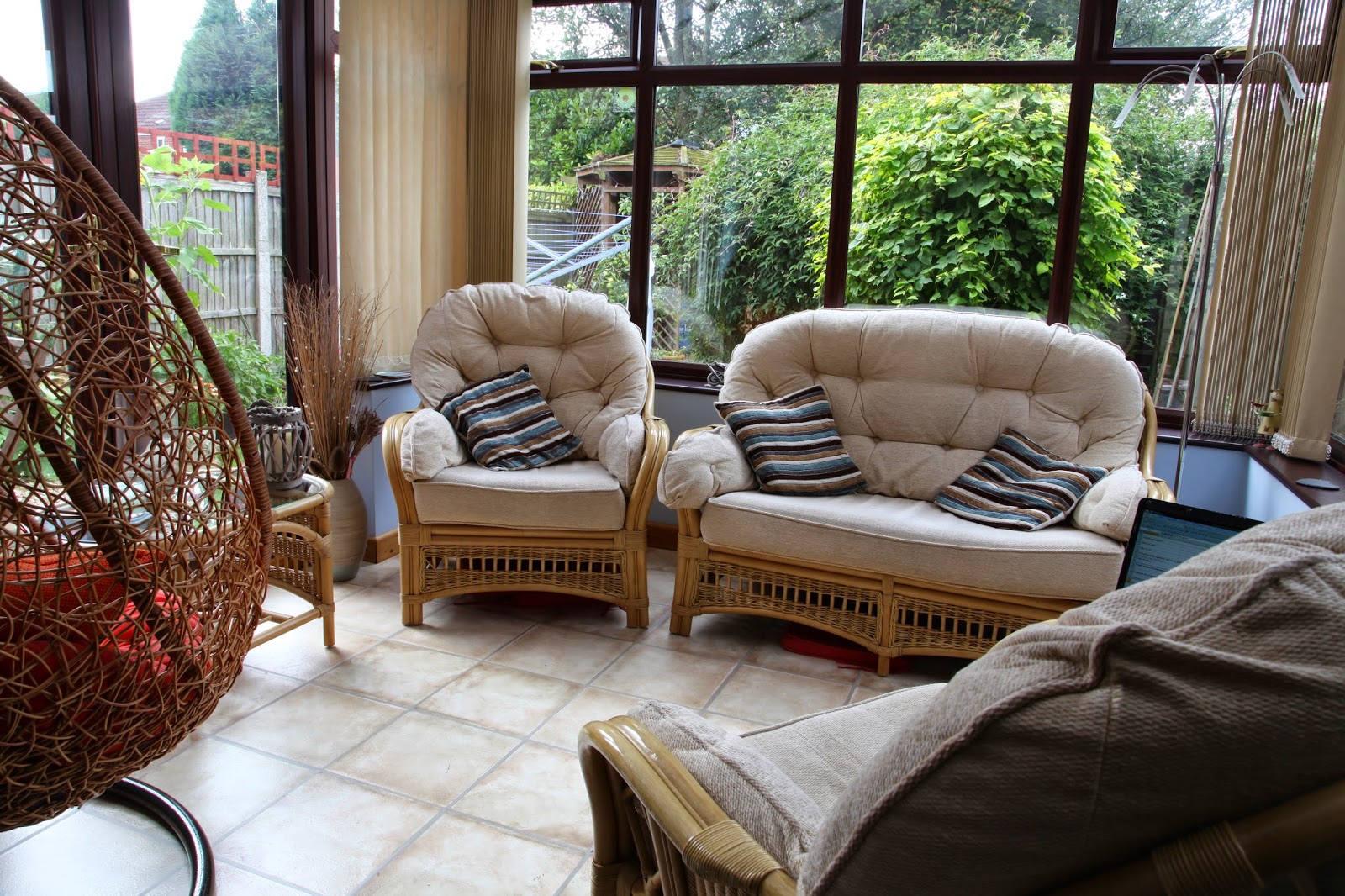
For this exercise I set the camera up mounted on a tripod at the entrance to the conservatory and marked the floor with tape in case anyone brushed against it altering its position. I took a series of photographs throughout the day, making observations of the images at the end.

This was possibly not the best room to choose, although when I sat in the Orangery for my assignment shoot, I was glad I understood where the shadows would fall and how it may look on camera.

Weather sunny spells and overcast, sun rises at patio doors and sets above convector heater.
8am
Can define shadows.
Already overexposed at camera's meter readings.
See through windows so light fairly even inside
Shadow details in corners
Furniture looks a little underexposed
9am
As above but furniture and floor looks brighter.
More shadows present e.g under chair
10am
Foreground in deeper shadow.
Furniture looks darker.
Makes room feel more closed in.
Floor is quite bright and in danger of burnout
11am
Brighter outside.
No real difference inside
12pm

Colours and shadows starting to change.
Room looks larger.
Patches of burnout on floor
More contrast
1pm
Colours back to dull (cloudy)
Lighting more even
Dark shadows under chairs
2pm
Deep contrast
Patchy, long shadows
Reflection in window
4pm
Direction of shadows altered.
Still deep shadows.
Overexposed white areas
5pm
Overcast
Reflection in window
No real contrast in shadow detail
8am and 9am best shot
Sidelighting from the left of the image gave the best effect to this room.

At 10am and 11am, nothing looked good - too much reflection or visibility through windows in all directions so focus was taken from the room. Needed a closer shot of a feature or chair.
12pm
Sidelighting on the other side of the room looked best, although there is too much reflection in the window
2pm

As above
4pm
Little deep shadow detail
Some light shadows present
Colour contrast shows up 

The user’s viewpoint

4/8/14
This exercise required choosing two or three buildings or spaces designed for a particular activity that is undertaken from a specific, distinctive position. I have tried to capture the users point of view. This required considering lens focal length, height and orientation.

Building 1

Assume that user is a visitor to Wollaton Hall

My first building was the dining room at Wollaton Hall, Nottingham, which housed an exhibition on a table a costume in a glass cage and a batman dressing up outfit. There were toys for children to play with and interactive displays. I felt the room was too cluttered and the children who wanted to pull out the batman cape had no space in which to do so. This was the main focus of the room.

-8252
1/40 f4 ISO500 32mm

I tried to show how visitors saw the display. There was evidence of people sitting down as the chairs were not pushed back under the table. I thought no-one was using this room and it appeared to be just a corridor. 

-8257
1/40 f4 ISO500 24mm
I liked this image of the Dad with the football under his arm. It illustrated to me that people came to use the Deer park as their foremost activity and the hall was of secondary importance. "Dad" is really not very interested in the room.

-8258
1/40 f4 ISO800 24mm
On my way out of the room, some overseas visitors came in. The lady became very animated and the whole room turned to look at what she was looking at. Using a wide angled lens and keeping the camera at the waist  height of the visitors enabled me to capture their body language and facial expressions. On reflection, I could have used different views to show the use of the room. Natural light comes in through the windows to help light the room and shadows are created adding interest. I still needed a high ISO to avoid using flash.


Learning points
This exercise was more difficult than I first thought. It would be better if I:
  • looked at what the visitors were looking at 
  • Included a mix of close up and wide angles shots. 
  • photographed the room from different angles and heights - e.g adult looking down on model, child's view


Building two

I looked at this room from the point of view of being a patient in an anaesthetic room. I decided not to use a model for this and just concentrate on the view the patient would see if they were laid on the trolley.


Patients come round to the anaesthetic room on a trolley and tend to turn their head to face the anaesthetic machine which looks unfamiliar to them. I used a wide angled lens to capture as much of their view as possible. I looked through the lens at using 50mm and decided to make the angle wider because the patient takes in more of the environment as their eyes wander as find something to look at.

-8299
1/6  f8 ISO100 24mm flash
This image shows the trolley sides in a raised position. It is necessary to use them to prevent the patient from falling off as the trolleys are exceedingly narrow. If the patient lies flat, their view is distorted by the sides.

-8309
                            1/50 f4 ISO400 24mm
I liked the diagonal line formed down the room - a barrier between the staff and patient.

This view included some of the patient’s pillow. Assuming that my invisible patient has turned their head to face the anaesthetist, the view across the room at 24mm was still quite narrow. In a real situation, the worktops would be covered, giving the patient more to look at.

At 24mm, the worktops look a distance away adding a feeling of space which is not there.
-8313
                            1/40 f4 ISO400 24mm
If the patient is given a general anaesthetic, they will look at the ceiling. I looked through the lens at 50mm and it only showed a small proportion of the ceiling. A focal length of 24mm from the height of the patient's pillow gave a view covering more of the ceiling. (An expected view)


-8330
1/30 f4 ISO100 24mm
This image assumes the patient is looking towards the other wall. 


-8338
1/30 f4 ISO100 24mm
This view assumes the patient is staring straight at the exit.

Images which didn't quite work:

I have finished reading Short (2011) and clarified my opinion on why I don't think think these images work.


This image is taken from the where the anaesthetist might stand. I focused on the oxygen tubing using a shallow depth of field. I felt that the emphasis was taken away from the patient because as the trolley became smaller in the frame so did the patient. My opinion is that the patient has become less important than the equipment.


The anaesthetic circuit which delivers the gas to the patient is something which the patient will be aware of as they are drifting off to sleep. In hindsight it would have worked better showing the mask and some circuit with an out of focus room. This may have conveyed the feeling that the patient was losing consciousness rather than being a picture of an object and added some symbolism to the image.

Building 3

I looked at the sheds in my garden and tried to put together a narrative from the point of view of the user (me) fetching something from the shed.

1/60 f8 ISO200 40mm
The two sheds. This sets the context of the sheds. The image is taken from my shoulder height when walking towards them.

1/15 F14 ISO400 82mm
A closeup of a padlock on one of the sheds. I attempted to show that the sheds are not used very often and over time cobwebs form. The viewpoint of this is looking down on the lock to open it. The attached washing line adds some interest. I included some of the floor as it gave a greater depth of field which added to the image. 
1/25 f8 ISO400 95mm
One shed has a broken window. I deliberated over how much of the window needed to be included in order for the inside contents to become visible. This image shows the context of the window and has a greater depth of field. However, the corner  piece of wood holding the roof on is distracting.

1/25 f8 ISO400 140mm
Close-up view through the broken window. This shows the contents through the window in more detail. 


1/4 f8 ISO400 95mm
Inside the shed. This was taken without flash, using the natural light coming through the broken window and slightly ajar door. The shed is too cluttered to allow access for many more images.


Bibliography
Short,M  (2011) Context and narrative, AVA publishing, Switzerland 

Exploring function

4/8/2014


This next set of exercises is designed to look at how people use indoor space. People can be included within the shot or there can be evidence of human activity. Viewpoint and composition will be important. I was looking forward to this set of exercises, although on reflection, I thought this set of exercises would be challenging. “Narrative” sprang to mind, and I thought these images should help to tell / complement a story rather than be a collection of rooms and buildings.

Having read through this set of exercises, I realised I needed to start planning some buildings / spaces to look at which would help when it came to my assignment.  Ideas would hopefully form a shortlist to work from and keeping my eyes open when out and about would be useful. A mix of old and new buildings was a must.

Southwell Minster
Cresswell Crags Visitor Centre, Derbyshire
Wollaton Hall, Nottingham
Windmill – height Heage, Green’s Mill, Nottingham, North Leverton, Notts
Watermill – Hardwick Hall, Derbyshire
Industrial Heritage – Papplewick Pumping Station, Notts, Lea Holloway Pumping Station, Derbyshire, Industrial Heritage Museums – e.g. framework museum, Notts,
Nottingham Contemporary Art Museum
Derby Quad museum
Nottingham Railway Station
Sherwood Forest Arts and Crafts centre
Thornton Lodge, Thornton Reservoir, Leicsetershire
David Mellor Cutlery Factory, Hathersage, Derbyshire
Cricket pavillion
WI Meeting – East Bridgford, Notts
WI House, Newark, Notts,
work
Garage
Next door neighbours summer house
Aircraft Hanger – Newark Aviation Heritage centre
Village church
First World War Trench reconstruction, Sherwood Pines, Notts

This first exercise looks at the function of an indoor space,  how successful the space is and whether it is being used to its full advantage.

I visited Wollaton Hall in Nottingham; an Elizabethan house built in 1588 and extensively remodelled  with the last major change taken place in the 19th century for The 6th Lord Middleton. It opened to the public in 1926 and is now home to Nottingham’s natural history collection.  From what I remembered of it, it was a two story (accessible) building with a large entrance hall and some rooms off it – most of which hold taxidermy exhibits and a story of the Middleton family who used to reside here. I always found it dark and sinister and was not surprised that the house front was chosen for “The Dark Knight Rises” (2012).

Thinking about the entrance hall, what did I want the space to do? I thought it should be welcoming, introduce people to the building, it could be used as an exhibition hall and should display relevant paintings or armoury. There should be a “wow” factor in that the tourist would know that they were visiting something special. The visitors will be of all ages – tourists, university students, children and local residents. How should it appeal to everyone? The website suggests that there are trail sheets that children can do which change periodically. Events happen which need advertising and tourists need directing or questions answering. Provision needs to be made for people to sit and look at the artifacts or architecture.

I stood and watched the people who passed through the entrance hall to see how they used the space. As they entered through the door, they were greeted with a small exhibition. This was about a dinosaur theme park. Most people glanced at it and walked off. I felt that for the size of the room, the exhibition stand was too small.  the writing was difficult to read and it looked looked CAD drawings with not much explanation. There did not appear to be much about the owners of the house (but this was displayed in other rooms).The lady making badges at the white trestle table was sat on her own and children were not encouraged to make a badge. The paintings were in keeping with a natural history collection, although they were not being looked at. There were a couple of benches where people were sitting, and at one point a lady carried out a nappy change on one. The “meet and greet” chap was on hand to answer questions and guide people through the room.

I stood and waited, watching people and took a few images on how the room was being used. This shot to me demonstrated the size and height of the room, the isolation of the badge maker,  the gait of the meet and greet person and some visitors striding purposefully across the room. I went back about an hour later and the room was still being used in the same way.

-8240


I felt that the space was not being used to its full advantage. More use could be made of the space and children encouraged to participate in activities. The exhibition could be more eye catching and larger so that people looked at it. "Batman" was relegated to the gift shop and one dressing up costume in another room. 


Bibliography
http://www.nottinghamcity.gov.uk/article/22204/About-Us#history accessed 1/8/14
http://www.thedarkknightrises.com/dvd/home.php accessed 4/8/14
http://www.imdb.com/title/tt1345836/locations accessed 4/8/14

Response to tutor feedback Assignment 2

September 2014

Overall Comments
I  was pleased with the feedback received from my tutor for this assignment especially as I had chosen a different event because had not been confident that my first set of images were of an  acceptable quality to become assignment images.

" Your choice of theme works well as it offers the photographer a good range of subject matter to try and capture. Obviously there will be an emphasis on the action shots but also images from behind the scenes and those quiet contemplative moments from competitors and spectators are also what draw the viewer in." 

"Your submission and background work reflect this with a varied range of images that keep the viewer interested. The strongest images are the action / race shots and these combine well with the more snapshot styled photographs." Tutor report July 2014


Assignment Feedback  
I used a couple of Cartier Bresson quotes to back up my reasons for not using flash at this event. I take my tutor's point about flash bringing out the colours and being helpful to balance the lighting when shooting in strong sunlight. I felt uncomfortable using flash as I did not want to put the competitors off.


I had experimented using looking up at the competitors as they rode a technical section, but these were edited out of my final selection. It is something to consider in future when selecting images for assignments.


One of my favourite images was the chap rebuilding the wheel. I would have liked to include more of this, but there was not much activity happening whilst the racing was on. The race was only an hour's duration, and all the races started within minutes of each other. More racing was timetabled to happen on the Sunday.

It was helpful to receive feedback on how I could improve my final image (water bottle). I think it was a case of knowing what I wanted to do but not how to achieve it. 

Learning blog
Helpful hints included:  
  • making sure the navigation is clear and easy to use 
  • Continue adding to my reading list


Further reading 
Look at the work of:

Having looked at Ricky Adam's website on the BMX culture, I can see what my tutor means about dynamic imagery. His photos work well as a whole - location, colour, action and parts of bikes. It showed me that it was acceptable to take risks, be more creative and include just parts of rider and bike , the latter being something I had debated over. I will be practicing taking some images at a night mountain bike race so will have to use flash.

Ricky Adams

Ricky Adams is a BMX bike photographer who works for a BMX magazine taking and editing images as well as having other projects on the go. He goes out on his BMX with kit as light as possible but it does include flash and lights as well as different lenses. His images have a grittiness / grunge /urban look to them which I would associate with this culture having been to the cycle show in Birmingham observing stunts and culture on display  to the public. Watching lads on BMX's at a newly opened pump track allowed me to appreciate some of the culture of BMX riding. Adams's work is different from mountain bike magazine images although I can see similarities and I think his style of images would work (not so sure about the injuries - I have not seen injuries published in a mountain bike magazine!) I do love the quote used regularly by Guy Martin in his TV series that if you don't fall off you aren't trying hard enough which most mountain bikers sustaining injury joke about.

Having looked at Ricky Adam's website on the BMX culture, I can see what my tutor means about dynamic imagery. His photos work well as a whole - location, colour, action and parts of bikes. It showed me that it was acceptable to take risks, be more creative and include just parts of rider and bike , the latter being something I had debated over. Looking back over my images, this is one that I had rejected at the time as it only showed a part of the bike. It does however, show the rider's muscles working and is more dynamic because of the shooting position and action that is being shown. I think it would be more acceptable to me if it was in landscape format. I will be practicing taking some images at a night mountain bike race in October so will have to use flash.


http://blog.defgrip.net/2010/02/interview-ricky-adam/ accessed December 2014


Ricky Adam (http://www.rickyadamphoto.com/digbmxcom/) accessed August 2014

I was interested in the work of Vivien Maier and the documentary of her life. What came out of it for me was the quote about her being a like a spy. I think that is how I have to view street photography.

Vivien Maier

Vivien Maier is described as a Mary Poppins like character who photographed the world around her through a square format camera which she held at waist height. To enable her to take close up portraits of her subjects she had to be about 3 feet away from them. To learn more about her work I watched the BBC programme on her called "Who took Nanny's pictures". What I like about her work is the way in which she captured the portrait of the person, and usually in the only picture she took of them. I believe her daily walks enabled her to practice her art.

I looked into her work at the start of part 3 which helped me look at how people use public spaces. Her work resonated with me especially through part 4 and 5 of the course. I had to think of doing the exercises as spying on people, like Maier used to do. I came back to her after visiting an exhibition at Nottingham University on Lee Miller's work after an in depth discussion about how a curator chooses someones work to be displayed and whether the deceased photographer would accept the portrayal of their work.

The story of how the work was found initially in storage, then sold at flea markets and reconnected once auctioned off, then pieced back together by people and studied by a lecturer  fascinated me, when clearly Maier is portrayed as such a private person who kept heself to herself. I noted that from her work, her influences could be analysed, such as after Jean Bertrand had stayed with them and then after visiting an exhibition by Henri Cartier Bresson and other photographers. A style could be seen emerging - her own voice - from the analysis of her images, and I wondered if the change in her images to show negative images and destruction later in her life was influenced by the Chicago riots or whether her personality was more like her mother's and she needed to express the change in her life.

I aspire to take images like Maier's and know it will take time for self  improvement. I am also different from her because I am not prepared to endanger myself by wandering the streets of the rougher inner city areas alone.

http://www.veoh.com/watch/v70590131KFPFjY7N?h1=BBC+Imagine+%282013%29+Vivian+Maier+-+Who+Took+Nannys+Pictures accessed dec 2014http://www.vivianmaier.com/about-vivian-maier/ accessed dec 2014


Saturday, 19 July 2014

Assignment 2 People and activity

Assignment 2: People and Activity
Introduction
For this assignment I have presented 10 photographs of people in some form of meaningful activity. From the categories listed, I chose a sporting event because I am interested in mountain biking and had some experience of what could happen at the event as I had watched a different race series evening last year at the same venue.

I originally looked at people involved with presenting the First World War at a living history event for my assignment. These were passionate volunteers who were informing mostly children with adults as bystanders. After reviewing my images I realised that it had not gone to plan. I also felt I could have included more close-up work so scrapped the idea and found another event to visit. (posted in Test Shots on blog)

I considered each assignment image individually and identified what worked well, what was less successful and analysed the reasons for this. I considered where I need to strengthen my skills and understanding and explained how I hoped to achieve it.

British Cycling hold a National Cross Country Championship during the year which takes in different parts of the country. This was the 4th round and featured 2 days of racing. I attended the first day which held one race made up of various categories: fun male and female, open male and female and sport male. These categories were non ranking. Sunday’s races included elite athletes who compete for points to enter the Olympic Games and other such competitive events. I thought this would attract more crowds and I could probably get closer to the action on Saturday.

In the planning stages of the assignment I revisited a rough plan I made for an event I was going to for a MTB marathon. (This event turned into my wide angled exercise as I was not ready to do the assignment at this point).

Plan 


As Cartier-Bresson (1999) describes “Things-As-They-Are offer such an abundance of material that a photographer must guard against the temptation of trying to do everything”. By making a detailed plan and narrowing down the content on the day when I saw what the potential was, I 
was able to put together a relevant picture story.

In order to select my final images, I categorised my images as I went through them, writing down a 

number under a heading. I then selected 20 from these and printed them off to arrange on paper so I

could move them around.  This allowed me to visualise all the images together, check for telling 

moments and ensure the activity is explained. This method helped me to look at facial expressions

 and body language and avoid repetition in my chosen selection. Cartier- Bresson (1999) writes that

 “after developing and printing, you must go about separating pictures which, though you know are all

 right, aren't the strongest”.

Images which did not make it into the final selection are on my blog under Test Shots.

I set up and used my Canon 5D full frame with a 24-105mm and Canon 40D (smaller sensor) with 70-300mm which gave me a focal length of 112-480mm.

Date: 7/7/14
Venue: British Cycling National Cross Country MTB Series 4 Sherwood Pines, Nottinghamshire
 Image 1   
 Canon 40D 1/250 F8 ISO100 Effective focal length 184mm
This was the start of the race. I picked out two riders who were relaxed and ready to start. There were still a few minutes to go at this point. The riders were set off in groups according to their class and this was the first group to go. I thought the colours worked well together and these two riders looked evenly matched. In the body language displayed, one rider has copied the other suggesting that the two are relaxed and at ease with each other.

What went well?
·    Telling moment - Riders sharing a conversation (looking for facial expression and body language)
·     Explaining activity - Relaxed body position – start of race – other riders busy with personal preparation
·      These two riders isolated by using a tight crop in camera and a telephoto lens
·      Number board state exactly what the race is and the venue
What could be improved?
·         Stand further back and use a longer telephoto lens to isolate riders further
·         Whole wheel could be included
·         Slightly overexposed

Image 2  
Canon 40D 1/250 F8 ISO200 Effective Focal Length 288mm
This image was taken as a group of riders set off and were competing to overtake each other before the track turned into singletrack. I like the movement, spacing of the riders, body language and the fact that there is a clear rider in front. I think it is a little cluttered with spectators.

What went well?
·      Telling moment  - action shot shows power, determination, dust being kicked up on the track
·   Explaining activity – numbers visible, British cycling banner visible, spectators on edge of course
What could be improved?
·      Too cluttered – would be more effective without the spectators

Image 3  
Canon 40D 1/350 f5.6 ISO400 Effective Focal Length352mm
This rider was showing a lot of determination and very focused. The colour of his clothing made him stand out against the background.

What went well?
·        Telling moment  - action shot shows power, determination, focus, concentration
·        Explaining activity – number visible, body position and muscle movement make him look as if he is working hard and racing rather than on a leisure ride
·       This rider was not under the tree canopy at this point making him better lit
·   Telephoto lens separates rider from background. Using the 300mm on a smaller sensor camera gave an even longer focal length
What could be improved?
·      Background too cluttered. The technical challenge was knowing where to stand to capture the rider in the sun without using flash with a clear background.


Image 4
Canon 5D 1/320 F4 ISO400 82mm
These two lads led for most of the race. I included a race scene to show a part of what the event was about. Most of the course was under a tree canopy which meant using a reasonable ISO. If I took images of riders under non race conditions (who are aware that I am taking images), I would use a flash. However, in a race, I did not want to put the riders off.
What went well?
·    Meaningful activity – race important to both of these riders. Rider in front shows determination – rider behind looks like he is slowing down
·   Telling moment – both team mates looking in same general direction round the corner- the one in front is looking round the corner. Although the corner in the track is not visible, the grass is flattened which gives a clue to the viewer
·      Wider angle includes more of the race circuit
What could be improved?
·     Image would benefit from fill in flash as the riders are under the trees.

Cartier- Bresson (1999) makes a valid point when describing how a photographer should work: “no photographs taken with the aid of flash light either, if only out of respect of the actual light – even when there isn’t any of it. Unless a photographer observes such conditions as these, he may become an intolerably aggressive character.” I agree with this and avoid using flash in some situations; instead working with a high ISO and a wide aperture as using flash would be off putting for the rider

Image 5  
  
Canon 40D 1/250 f8 ISO400 Effective Focal Length 480mm
This rider was nearing completion. He shows real determination and pain. This is one of my favourite images. The colours are harmonious and the fluorescent jacket in the background is not too distracting.

What went well?
·         Telling moment  - action shot shows determination, pain, focus,
·         Explaining activity – rider’s body position, facial expression
·    Telephoto lens worked well especially at this length to show the rider’s facial expression. Background blurred to avoid distraction
What could be improved?
·   Crop to remove Garmin (although riders use these for checking their personal records post race)
·       Fluorescent jacket in the background is a little off-putting

Image 6       
 Canon 40D 1/250 F8 ISO800 Effective Focal Length 352mm
These two spectators were in close proximity and I am not sure if they were together or not. They were spectating at the technical section of the track – a hand built wooden bridge that some people were finding it difficult to ride. The young lad’s race had finished and he looked thoroughly fed up. He was playing with the tree rather than watch the race. The lady has an interesting facial expression – I couldn’t decide if she was worried or bored.  The boy’s bright helmet draws the viewer’s attention to him.  The longer focal length separates the people from the background.

What went well?
·         Telling moment  - boredom – boy playing with tree on and off
·         Explaining activity – action of playing
·         Long focal length and my position next to the track enabled me to shoot under the pretence of taking a photograph of a rider
What could be improved?
·       A lower camera angle may catch more of the boy’s face
·         Image could be sharper. Moved camera focus to AI Servo to track the riders and forgot to alter it back for this image. Need to remember which camera I have in my hand.

     Image 7
Canon 5D 1/800 f4 ISO400 50mm
A group of spectators gathered in front of me. Two had raced and one was using his phone to record the race. I liked the casualness of the group. There was no competitiveness between them. The man on the floor was engaged in conversation with man on the bike.

What went well?
·    Telling moment - spectators in conversation with each other – man on the floor engaged with the chap on the bike.
·      Explaining activity – spectators on edge of course – two watching the race and two engaged in conversation
·       Walked around the group and kept walking past until I was happy with the framing of the image
·       Colours are complementary
·     The standard focal length shows track and gives an idea of the perspective as the viewer can count the number of trees to give an idea of scale. I had included riders in the image but it became overcrowded and lost direction. I think this works as it shows the track and there is another spectator the other side of the tape.
What could be improved?
·    In the planning for this shot, I forgot to check my camera settings. Would work better with a smaller aperture and slower shutter speed. Men were under the trees and this was taken into sun.

Image 8
Canon 5D 1/400 f4 ISO400 105mm
This man was part of one of the teams and rebuilding a wheel. I asked him if he would be happy if I took some photos of him working. I thought his activity was relevant to the race and the items on display at the back of the tent was relevant – helmet and water bottles. The transparent window provided a different view of the spectators. I liked the reflection in the man’s glasses.

What went well?
·        Telling moment – repairing / rebuilding is part of racing.
·       Explaining activity – man occupied with mending a wheel – can see what he is doing and in the environment he is working
·       Colours work well together
·       Inclusion of the window adds a different view of the spectators
What could be improved?
·       I would not improve anything in this image

Image 9
 Canon 5D 1/400 f6.3 ISO400 105mm
This man is crossing the finishing line. There was not a finish flag, although there was a start flag at the beginning of the course. The commentator had asked that people did not stand in his way as he needed to see the numbers on the bikes. I tried to depict finishing with a water bottle and a hand as the man has made eye contact with the bottle. From his body language and facial expression, I assumed he was at the end of his race. I think this is the least successful of my images. It is a telling part of the event / sport

What went well?
·         Telling moment  - body language  - the man looks tired and fed up
·      Explaining activity – On such a hot day, the water bottle will be one of the first items the man needs
What could be improved?
·         Not quite in focus
·     I think the idea works but there needs to be more of the person’s arm who is holding the water bottle in the frame. Perhaps it should be the hand in focus rather than the rider?
·         There is another rider behind the man in the middle of the frame. I think if he was shown more, the image would work better. I would also consider cropping this so that the bike is on a third rather than in the middle.

Image 10
Canon 5D 1/100 f7.1 ISO400 58mm
I chose this podium image because the handshake and facial expressions are good. There is a lot going on within this image. The chap in the blue and white t shirt and jeans had awarded prizes to riders one and two. I liked the fact that everyone was happy and riders were congratulating each other. The rider with the yellow top on still had his helmet in place. I think some flash would have worked better but I did not want to be visible.
What went well?
·      Telling moment  - handshake, facial expressions show happiness, speed of event – rider had helmet on
·    Explaining activity – background shows a trailer in which a prize giving ceremony took place
What could be improved?
·        Use of flash
·      Telephoto lens (camera with telephoto lens was not set up for this and I didn’t have time to change it back)

Conclusion
In summary, throughout this assignment, I considered each image individually and identified what worked well, what was less successful and analysed the reasons for this.

Looking at my collection of images as a whole, there are differences between the facial expressions, body language on display, framing, angle of view, telephoto and standard focal length. I found it difficult to get a wide angled image in, although I had taken images where it looked like I was in the middle of the action. I think the timing of the actions worked and on the whole the viewpoint worked. The technical difficulty of the day was the strong sunlight and the race taking place under trees. I had no control over where the spectators stood or the direction of the race circuit so there are times when I had altered one camera to take one shot and picked up the other camera for another shot and forgot to alter the settings. I used two cameras and it helped me to capture the action without keep changing lenses. My learning point is to become familiar with both cameras (which are very similar) and it will make these situations easier.

On reflection, I made the correct choice to abandon my 1st choice and work with this event. I was initially apprehensive as I was working without flash and experience showed me that flash does help in these situations.


References
Cartier - Bresson, H (1999) The Mind’s eye, Aperture Foundation, New York, p24
Cartier - Bresson, H (1999) The Mind’s eye, Aperture Foundation, New York, p25,
Cartier - Bresson, H (1999) The Mind’s eye, Aperture Foundation, New York, p28,
Bibliography
Angier, R (2007) Train your gaze – a practical and theoretical introduction to portrait photography, AVA publishing, SA
Badger, G (2007) The genius of photography – How photography has changed our lives Quadrille Publishing Ltd, UK
Cartier Bresson, H (1999) The mind’s eyeAperture Foundation, New York
Dyer, G (2012) The ongoing moment, Canongate Books ltd, Edinburgh
Short, M (2011) Basics creative photography - Context and narrative, AVA publishing, SA