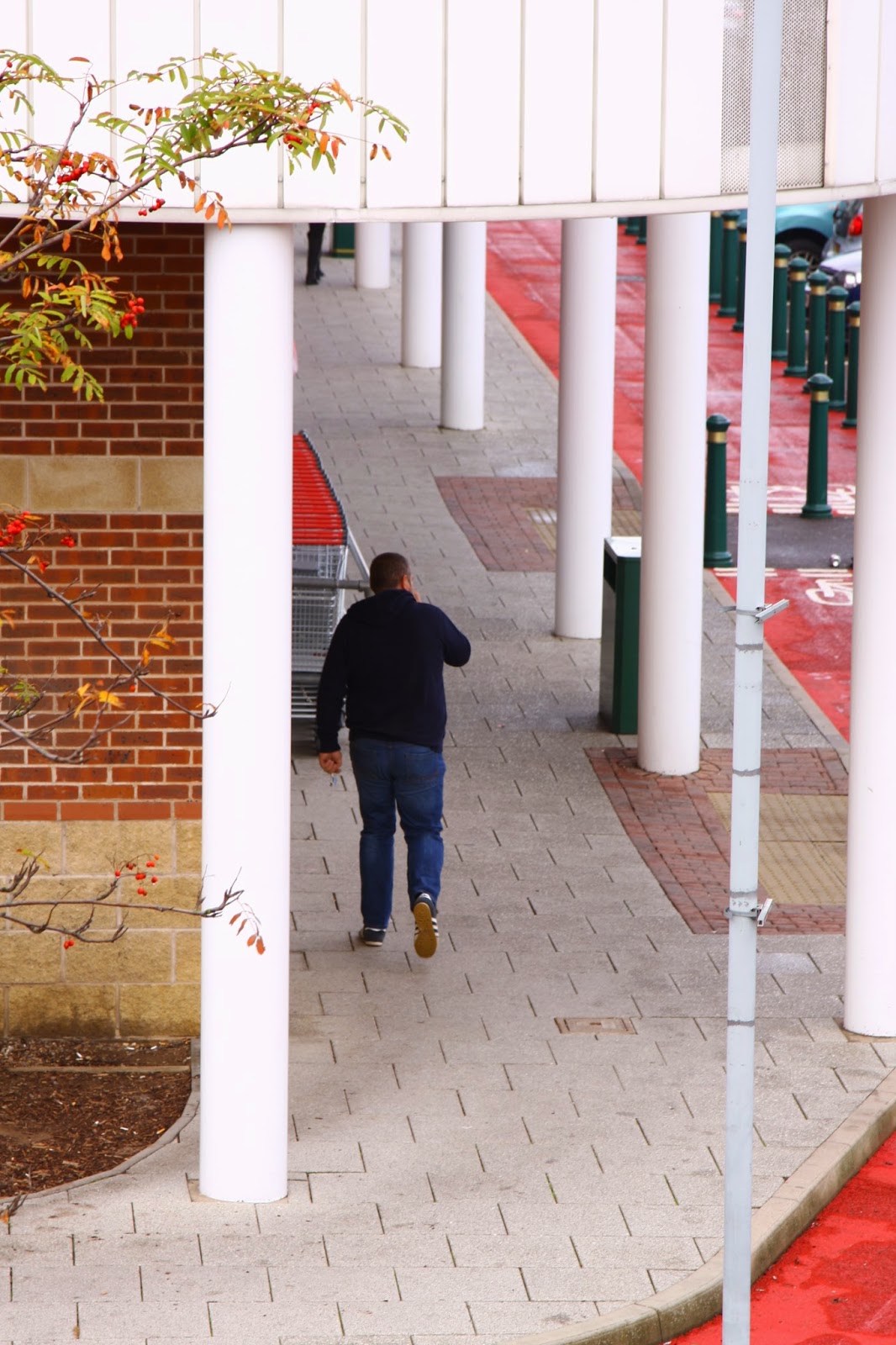
Assignment 4 A sense of Place
This assignment draws together all
the learning from the previous exercises and the appreciation of what buildings
and spaces mean to the people who live amongst them. The aim of this assignment
is to produce enough images to fill a six page, intelligent, thoughtful travel
publication (not touristic). In total 12 photographs are to be chosen with 6 to
be selected as a first choice.
Whilst working through the set of
exercises for part 4, I moved around through various locations fairly close to
home. In part 2 of this course, I encountered issues of feeling uncomfortable
with photographing in my home town of Mansfield. I gained in confidence during
part 3, and put it to the test again in part 4. At the beginning of the
exercises I still felt uncomfortable and sensed that people regarded my actions
as suspicious (I think because it is a town of high unemployment and benefit
claimants) so I decided to use my local city to “hide” and work through a
period of self-development, gaining confidence with street photography. Eric Kim
wrote an article published by Digital Photography School which I found very
helpful, suggesting that if one stood in the middle of a road junction, no-one
would take any notice of that person, which put photographing people without
asking them into perspective for me. Having looked at the idea of basing this
assignment in Lincoln because I could hide behind the mask of a tourist, I felt
I would get more out of the assignment by challenging myself and using Nottingham
which I know equally well. The point of decision came when I was asked if I
would be willing to take some photographs for a friend who is writing for a
winter sports magazine of Winter Olympians in Nottingham.
The essential character of Nottingham
I held my own opinions of the character
of Nottingham and to test whether these were similar to other peoples, I
discussed them with a number of work colleagues. I was interested to note that
how one views Nottingham and what one associates with depends on social class
and sex. Men tended to look at the buildings from the outside whilst women saw
it as a place to socialise, meet friends and shop. Not everyone went out to eat
in Nottingham (only those who were more affluent or going with work colleagues.)
Nottingham is famous for the legend of Robin Hood, and the tourist attraction
closed in 2009 (5 years ago). It seems that since then, Nottingham entered a
period of decline with shops and businesses closing down fairly quickly. Last
year the city ran a project to fill 20 shop windows with exhibitions in an
attempt to make the shopping area more enticing to consumers. University and
student accommodation buildings are now on the increase along with the
redevelopment and modernisation of two shopping centres and zones are being
created such as the Lace Market (Cultural Quarter) and Sneinton Market
(Creative Quarter).
I see the redevelopment in a positive
light. Nottingham has been the founding home of huge companies such as John
Player Tobacco, Boots Pharmaceuticals and Raleigh Bicycles. Nottingham’s
history involves lacemaking in cottage
industries and within the city, Robin Hood and the Sherriff of Nottingham are
world class fictional characters and sporting legends such as Jane Torvil and
Christopher Dean, Carl Froch and Brian Clough have over the years captured the
lives of many and put Nottingham firmly on the map. Nottingham is proud to
present two long standing football teams (Nottingham Forest and Notts County),
a National Cricket Stadium (Trent Bridge), National Water Sports Centre,
Nottingham Panthers Ice Stadium as well as concert venues such as Capital FM
Arena and Rock City. Fashion designer Paul Smith also comes from Nottingham. We
boast two Universities; Nottingham Trent University and The University of Nottingham.
More recently we had a visit from Batman as Wollaton Hall became Batman’s home
in The Dark Knight Rises, and tourists can find the village of Gotham not too
far away. Nottingham has a lot to offer to investment companies, students, tourists
and locals alike.
The Council House boasts two art deco
lions; Leo and Oscar. Leo is the Left Lion, and one of the cultural magazines
sports this name. The Left Lion is a well-known meeting place for people of all
ages. The Old Market Square, the largest in the country, holds food fairs, shows,
Christmas Markets, the Seaside in Summer for children and political demonstrations.
At lunchtime, workers and visitors alike can be seen sitting around. This is
where the youth of today meet. The fountains (redesigned from old public
toilets) provide a playground for toddlers to teenagers whatever the weather. Nottingham has several buskers, but none
replace the memories of the Xylophone Man who always played outside C and A and
died 10 years ago. A petition was started to ask NET to name a tram in memory
of him. Nottingham also has its own religious informers who have the same spot
outside Marks and Spencers. Nottingham, like most cities, has its own dialect,
although this is harder to capture in photographic form.
What I set out to achieve
I started off with quite negative
thoughts towards this assignment. Having
read around street photography and visited the exhibition at The University of
Nottingham on American Night Photography (see exhibitions page on my blog), I
was left wondering how to present this positively. Nottingham is trying to move
with the times to upgrade the derelict areas and attract more people in.
However, I feel that money is not always spent in the best of ways such as the
closure and redesign of a public space at great cost to the taxpayer within 2
years of a makeover. Change is always
going to be there – some people see is as positive, some as negative such as
the stall holders of Sneinton Market who are unhappy that their market is going
to be turned into a gaming area. There are less affluent areas, and gun crime
is high, so for my own safety I planned to stay in the safer areas. Nottingham
is a large city and if I took images of certain buildings, I would waste space
on a “snapshot of Nottingham’s buildings”. I narrowed my area of Nottingham to
within a 1 mile radius from Left Lion, in the Old Market Square of Nottingham.
This encompasses several of the landmarks of Nottingham that people use and or
associate with.
I drew up a list to carry with me to
look at certain aspects.
My list of suggested shots:
Citycard Bike hire long shot towards
city
Left lion across market square (busy
people)
Trams up South Parade (side of
council house flying horse walk) – busy traffic
Park Tunnel (city of caves) – single
person? steps
Sneinton Market redevelopment no
people
Busker / Religious informers
Nottingham Trent University (Newton
Building) Students (group) small and many
Nottingham Playhouse (Sky Mirror) / Broadway
Cinema (people anonymous) silhouettes in windows
Maid Marion Way (legend of Robin Hood
without using the statue)
Exchange Walk or Kings Walk (shopping)
People in coffee shops (or outside)
Groups of picnicking people in market
square
People at tram stops
Ice arena
I planned my images to be bright and
colourful to attract people to visit. This meant underexposing slightly to make
the colours more saturated to add colour to the cold, grey winter season.
Puddles would be acceptable and add another dimension for reflections.
Christmas lights may be unavoidable and I wanted lots of people to show
Nottingham being busy. Nottingham has worked hard to incorporate a continental
feel with cafes extending their seating to outside, but I didn’t think I would
capture this at this time of year. I wanted a sense of scale and to show off
Nottingham’s better side.
I used the same camera throughout
(Canon 5D mark 2) with the same lens (24-105mm) to capture wide angles, height
of buildings and a tripod for the night time images. I used a variety of
portrait and landscape and spaces where captions could be added.
I wanted to make people feel that
they could associate with the people of Nottingham, even if it was to say “I
behave like that” or “that looks like …..”
My images
.png)
.png)
Discussion took place around whether
Robin Hood was a landmark or a tourist attraction.
Set 1
.png)
.png)
Why these sets are organised as they
are
Set 1 tells a story of what is
happening in Nottingham, from what the city council wants to showcase (the posh
shopping centre and lit up council building) to our more creative side (knitted
bicycle stands and the busker) and what the real people get up to. Set 2
provides an alternative couple of images such as the cinema at night and what’s
really going on behind the scenes (Sneinton market buildings being regenerated
and people in alleyways.) The 2 people shopping are down a pedestrianized street
showing Ted Baker and Hollister on one side to the British Heart Foundation on
the other. The religious speaker shows how people keep a wide berth and on a
busy shopping day, this space is not being utilised to its full potential.
|
|
 |
| 1/80 f8 ISO800 24mm |
The building is light and airy with a
glass domed roof making it feel cathedral like. It was important to capture the
sense of space and height, lighting and smartly dressed people. The people show
the scale of the building. I was unsure of the photographic policy of this
building so I handheld the camera although it would have been better taken on a
tripod. I used a high ISO to obtain a fast shutter speed and I think the amount
of grain is acceptable. By standing slightly off centre the building is not
symmetrical, and shows the direction of travel of the shoppers. The building is busy, but not as
busy as the other shopping centres. The people are not recognisable on their
own as they are small in proportion to the building and there are several of
them.
 |
| 1/30 f8 ISO400 24mm |
This image captures the creativity of
Nottingham’s Creative Quarter. Geographically the creative quarter encompasses
Sneinton (will be home to a five storey video games exhibition in conjunction
with Nottingham Trent University and the Science Museum), the Lace Market –
centre of the lace making industry during the days of the British Empire and
Hockley (where this image is taken). The tall Victorian buildings (one of which
was owned by Jesse Boot founder of Boots of Nottingham) are home to the
alternative shops such as gothic and vintage clothing shops with a number of
bars and restaurants with outside seating. This image shows different coloured
knitted covers to the bike racks which I think express creativity. The two
passers-by on the left hand side of the image have shown an interest in what I
am looking at. They are motion blurred making then less distinctive. The day
was cold and misty depicted by a trail of cigarette smoke. The bikes added a
splash of colour to the image. Nottingham’s winter deal for the lime green city
cycles is to make them free to borrow which is a great idea, and meant they
were not at the locations which I had planned to capture them so this was my
alternative idea. Nottingham is home to Raleigh bikes so bikes had to feature
on one of my images.
Todd Hido (2014)(p20) suggests that
when one is photographing space, “it is useful to use the perspective to draw
the viewer into the frame. The diagonal line creates depth, and depth often
works well in describing an environment. The diagonal lines extend your
photograph into infinity.” I discovered this was true when photographing the
space inside Southwell Minster, and one can imagine how the line of buildings
looks going off to the left. I also believe that in this instance, repetition
of the buildings fools the brain into repeating the pattern. This does make the
space look larger.
 |
| 1/100 f8 ISO640 45mm |
Low Pavement (above) used to be one
of the main coaching routes in Georgian times. The last white building on the
right hand side towards the centre of the frame was the old assembly rooms. All
the buildings are listed and several contain caves as basements. The point at
which I am standing is the main thoroughfare through the designer shops and
links to the second shopping centre and the Lace market. Jamies’s is marketed
as family friendly dining so I included the child in the image. I had hoped to
capture alfresco dining, but the time of year was against me. However, people
do look at restaurant menus. I like to think of Nottingham as becoming more
multicultural and inviting people to have the opportunity to sit outside.
The two red telephone boxes have
become a landmark for the people of Nottingham. This image shows that
Nottingham is not flat. It also illustrates the mix of modern and old buildings
which can be an eyesore or urban infill depending ones views on architecture.
 |
| 1/40 f8 ISO400 58mm |
Whilst in Nottingham, most people
come across the street busker. I wanted to capture the loneliness of this chap
and people’s attitudes towards him. This
image hopefully captures the tension surrounding him. In this image, the lady
on the right is waiting for someone. She may hear his music but she is not
watching him. The lady on the left is marching straight past him pretending not
to notice him. The other people are already on their way out of the picture.
His violin case did not have many coins in and this image was taken at 3:19pm.
A higher vantage point would have helped capture the lack of money. (I was
below him and the walkway goes uphill). The image would be better if it
included more of the lady on the left. She was on the edge of the frame and my
image needed straightening slightly. This was an image where I had to
demonstrate quick reactions. I saw something and acted upon it.
 |
| 1/50 f8 ISO400 75mm |
Friar Lane, Nottingham has nothing to
do with the story of Robin Hood and Friar Tuck. One may be excused for thinking
that the two are linked, given that its location is fairly near to the castle.
The name comes from the Carmelite Friary (visited by King Henry 8th),
although no trace of the building remains. To me, this image shows the real
Nottingham; kids sitting on the pavement waiting for a bus, exhausted shoppers,
and behind the bus stop is Chocolate Utopia which in my opinion looks dirty and
unappetising. Even the silver birch tree has been chopped down leaving a tall
stump.
 |
| 0.6secs f8 ISO400 50mm |
This is my favourite image.
Nottingham’s Council House dome is lit up for occasions such as Children in
Need, Nottingham Night Light and as part of the Christmas decorations. The
colours change and unless I take several images, I cannot guarantee what
colours I will have on the image. I was
pleased with the blue lighting which is both masculine and emotional. I mounted
the tripod on the edge of the fountain which was above head height and stood in
a trough of water, waiting for the man on the left to stand still. Fortunately
he did, and the people with him moved away from him. The man is balanced by the
lights on the right hand side and the hint of Christmas decorations on the left
sets the time of year. Separating the image from the reflection are a group of
people enjoying themselves on the temporary skating rink. I liked the fact that
the man has long hair and a carrier bag. When I analysed this image on the
computer, I decided could see more about it than when I took it. It told a
story of a man looking at the Christmas lights and wondering about the expense
of it all. I thought it was quite reflective (contemplative) as well as the
reflection adding to the “stop still and think” notion I was trying to convey.
I was inspired to revisit night photography after seeing Todd Hido’s work at
the University of Nottingham this month and reading his book.
Set 2
 |
| 1/80 f8 ISO500 24mm |
The statue of Robin Hood was gifted
to the City of Nottingham in 1952 by a local businessman to “provide something
tangible for visitors to see relating to Robin Hood” (http://www.experiencenottinghamshire.com/discover/robin-hood-statue-p586071) accessed Nov 2014. The sculptor
based his work on historical references. It caused controversy when first
exhibited as the citizens expected to see a piece of work based on the 1938
Errol Flynn movie entitled The Adventures of Robin Hood. Robin Hood is now
located outside the Castle walls which befits the legend. The statue certainly
draws the tourists and people queue to have their photograph taken next to it.
The statue stands on a narrow
concrete plinth about 2 feet high and becomes very slippery during the wet
weather. Without a step, I found it difficult to balance on such a narrow
plinth and take the image. The image could be better if there were less
tourists around (e.g. on a weekday) and if I had carried and used a step (which
was impractical). The tourists in the image are small and many, making them
unrecognisable. It gives a sense of scale to the image, although not arranged
brilliantly.
 |
| 1/125 f8 ISO500 55mm |
This image of Bridlesmith Gate from a
low perspective captures most of the reflection of the two shoppers in the
puddle. The designer shops are mixed in with one charity shop. The buildings
along this stretch are a real mix of old and new. The man with a Moss bag
hurrying through the shoppers adds movement to the image. I found a photograph
taken by Francis Frith in C1950, in which the shop front of Coast onwards on
the left hand side look similar. In those days the road still had cars
travelling along it.
 |
| 1/80 f8 ISO400 32mm |
Sneinton Market through the eyes of
the developers was an interesting perspective. I came face to face with a security guard! People of Nottingham recall
Sneinton Market selling all sorts of things that you couldn’t buy elsewhere
during their childhood. It is part of Nottingham’s heritage with buildings
dating from the 1930’s. There has been a market here since 1860 and it was
always seen as important community space – not only the buildings here but the
open plan market square too. The square has undergone considerable
redevelopment – turning it from a car park in the 1990’s to a square with
colour changing fountains in 2014. On the recent occasions that I visited, the
space was occupied by 3 sellers determined to hold a market although people
just use it as a place to walk through on their way to the city centre.
The day I took this image the day was
foggy and cold – in keeping with the run down area. I think the fact that it is
boarded up with a skip outside suggests that work is happening and although
there are no workmen in the image, it still looks like work is imminent.
Evidence of constructive human activity is shown.
 |
| 1/30 f8 ISO400 32mm |
 |
| 1/13 f5.6 ISO200 105mm |
 |
| 1.6secs f13 ISO200 24mm |
Initially, I had wanted to include
silhouettes of people in the windows. Hido (2014) (p26) made me question
whether this was necessary or whether it was better to let people draw their
own conclusions on what was/had happened. Hido explains that “what’s not shown
is of more interest. It activates the senses.” I now agree with this and
questioned whether it mattered how many people were on the bus, or what the
people in the Cornerhouse building were doing.
How well I think I succeeded
My original plan had been to look at taking
images for an overseas business brochure. I narrowed down my images to include
a group of students outside the university, a scene with people including a
bank in the image, transport (bikes / buses / trams), eating out, wealthy shops
and people enjoying themselves. I looked at a few examples on the internet and
the use of bright sunny days made these images more cheerful and saleable.
Realistically to achieve this in October / November was going to be very
weather dependent, and unfortunately on my planned photography days the weather
was cold, wet and misty. Fortunately the time of year was great because at
weekends the city came alive with so many visitors and Christmas shoppers that
I times I thought I had too many people to choose from!
Conversely, some of my planned shots
were unattainable due to the Christmas Market. I had planned the left lion
juxtaposed in front of a mock Tudor shop front. On the occasions I visited
access wad denied as the Christmas Market was being set up or once up, it was
too cluttered.
Attending the exhibition on American
Night photography encouraged me to extend the time spent in Nottingham and look
at early evening nightlife, although at 6pm blue flashing lights constantly
drove up and down the city centre roads. I benefitted from knowing the city. To
include local colloquialisms, I had considered using a derelict railway grain
storage warehouse on a piece of wasteland which was within my mile of the city
centre which has Nottingham slang graffiti painted on it. I think this would be
a good future project which I contemplated but the thought of being
unaccompanied due to the structure of the building and its current use were
enough to stop me from visiting alone. There were enough people I encountered
sleeping in doorways and next to cars in the more run down parts of the city.
My list of places to look at helped save time and also meant I could plan a
rough circular route.
How I might have approached the
assignment if there was no end result in mind
I think my images would have been
more about the buildings than the people using them if I did not have and end
goal in mind. The assignment was good for focussing my mind, and once I became
absorbed into the subject, I became more confident at capturing images without
worrying what people might think. Am I done with this subject? I am happy with
the outcome for the purpose of the assignment as what I want to take will not
happen until after Christmas when the lights and market stalls are taken down.
By then there will be less people around and the weather will still be
unpredictable. I think this will be a case of carrying a camera around with me
when I go out and about. The exhibition by Hido came just at the right time for
me to open my eyes and make me take note of the world around me. I can now see
how I could do the assignment differently using other places Hido (2014) (p62)
suggests that “That’s when you’re done: when you’re not compelled to shoot the
subject anymore.” I still feel I have more places and people to explore and so
I can associate with this quote.
References
Hido, Todd (2014) on landscapes,
interiors and the Nude, aperture publishing, New York p20
Hido, Todd (2014) on landscapes,
interiors and the Nude, aperture publishing, New York p26
Hido, Todd (2014) on landscapes,
interiors and the Nude, aperture publishing, New York p62
Bibliography
ALHS N,
2009, Newark through time, Amberley Publishing, UK
Hido, Todd
(2014) on landscapes, interiors and the Nude, aperture publishing, New York
Freeman, M
(2014) Capturing light, The heart of photography, Ilex press, Lewes, UK
West, J
(2001) Memory lane Newark and District (Memory Lane) Breedon Books Publishing
co ltd Guernsey
Eric Kim,
Digital Photography School http://digital-photography-school.com/10-tips-for-the-aspiring-street-photographer/ accessed October 2014
http://www.nottinghampost.com/Creative-Quarter-support-nurture-Nottingham-s/story-19681078-detail/story.html accessed Nov 2014